


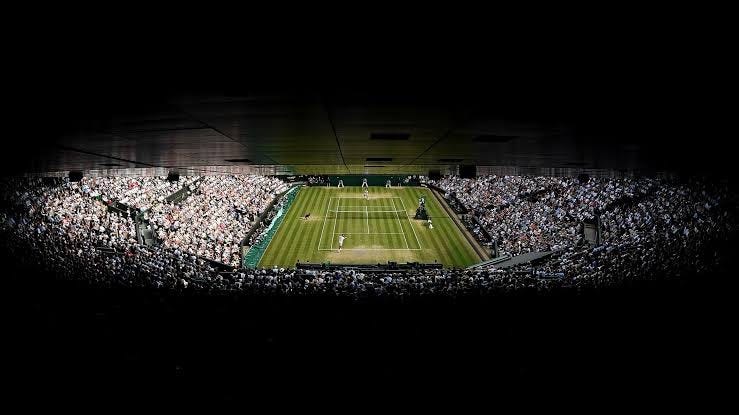
There was a time when Wimbledon’s men’s draw was less a tournament bracket than a royal family tree.
You could pretend to study the seeds. You could circle a dark horse, squint at the grass-court form, talk yourself into a left-hander with a serve or a Canadian with a backhand or a Frenchman having the kind of fortnight that makes tennis writers start using the word “liberated.” You could do all of that. Then, eventually, the draw would lead you back to the same three names.
Roger Federer.
Rafael Nadal.
Novak Djokovic.
If a coin had three sides, Wimbledon lived inside it.
From 2003 through 2022, the trophy almost never left their grip. Federer made the place look inherited. Nadal made every blade of grass feel like a personal insult he intended to overcome. Djokovic turned Centre Court into a late-stage administrative process: file the paperwork, absorb the noise, erase the opponent, collect the silver.
There were interruptions, of course. Andy Murray crashing the monarchy twice and earning a permanent place in the family portrait. A few challengers who made finals, a few mortals who took sets, a few men who found themselves standing on the other side of the net with the terrifying realization that they had not merely reached Wimbledon’s business end; they had reached the part where the business had been owned for a decade.
But the tournament itself remained safe.
Not safe in the sense of boring. Federer, Nadal and Djokovic gave us some of the highest sport has ever produced. They made tennis grander, more beautiful, more impossible. They made a best-of-five match feel like literature with sweat on it. Federer’s grace gave Wimbledon the illusion that it had been designed around him. Nadal’s refusal to die gave the place drama even when the grass should have rejected him. Djokovic made greatness feel like a hostile takeover.
Safe because the outcome had borders.
You knew where the story was going.
You knew the draw could dance, but it would not escape the palace grounds.
Now the palace is still there. The lawns are still perfect. The strawberries still cost too much. The queues still contain people who have convinced themselves sleeping on pavement is a spiritual practice. Centre Court still looks like the kind of place where a minor royal might accidentally become your line judge.
But the kings are gone, or nearly gone.
Federer is a memory with perfect footwork.
Nadal is an ache in the sport’s collective knee.
Djokovic remains, which is somehow more haunting than if he had left cleanly. He is still in the draw, still dangerous, still capable of making a younger man feel the full weight of 24 majors standing behind the baseline. But he is no longer the permanent weather system of the tournament. He is a seven-time champion trying to summon one last storm.
And that changes everything.
The first thing dynasties do is make uncertainty feel unnecessary. They do not just win titles. They compress variance. They train us to see the field as supporting cast. A generation of excellent players spent their best years living beneath the Big Three’s ceiling: Berdych, Ferrer, Tsonga, Nishikori, Del Potro, Cilic, Raonic, Dimitrov, Thiem. They were not frauds. They were not failures. They were very good tennis players who happened to play in a period when very good was a cruelly insufficient word.
The era did not just produce champions. It produced collateral.
Imagine being David Ferrer, one of the most relentless competitors of his time, and knowing that a typical path through a major might involve Nadal on clay, Djokovic in a semi-final and Federer waiting in some elegant corner of the draw like a man holding a champagne glass at the end of civilization. Imagine being Jo-Wilfried Tsonga, capable of making a tennis ball sound frightened, and understanding that even your best night might only earn you the privilege of meeting one of the three men who had turned the sport into a private estate.
That was the price of the golden age.
Everyone else got smaller.
Not in talent. In probability.
Now that compression is easing.
The new Wimbledon has not become a democracy. Let’s not get carried away. Tennis does not hand out fairytales the way football can. In football, one great goalkeeper, one set piece, one red card, one night where a stadium begins to believe can carry a country across a line. In tennis, an outsider has to survive seven matches. Best-of-five. No substitutions. No teammate to cover the bad quarter. No place to hide when the forehand goes missing or the serve tightens or the crowd turns the air thin.
Tennis is an authoritarian sport.
It asks the individual to stand there, alone, for two weeks, and prove that they deserve the whole thing.
That is why the Big Three were so terrifying. Their greatness was not only that they could peak. It was that they could repeat. They could survive the first-week weirdness, the rain delays, the awkward opponents, the five-set traps, the heat, the nerves, the press conferences, the expectation. They could do it again and again until the whole sport began to think of Wimbledon not as a tournament but as an annual appointment with inevitability.
But inevitability is a drug. Once you have lived inside it for long enough, uncertainty feels like danger.
And the draw is dangerous now.
Carlos Alcaraz is out with injury. Jannik Sinner, the defending champion and world No. 1, arrived as the obvious favourite and immediately got dragged through five sets by Miomir Kecmanovic. Sinner survived, because great players are allowed to survive ugly, but the image mattered: the safest man in the field bleeding, slipping, scrambling, reminding everyone that grass does not care about your ranking. Novak Djokovic is still there, still chasing an impossible 25th major, but he is no longer a certainty. Alexander Zverev sits near the top of the board. Felix Auger-Aliassime, Ben Shelton, Taylor Fritz, Daniil Medvedev, Alex de Minaur — all real players, all capable of causing problems, all carrying a different kind of pressure now that there is room to imagine more than a semi-final as a success.
That is the vacancy.
Not emptiness.
Opportunity.
The post-dynasty period is always misunderstood at first. We call it a decline because we are grieving the certainty. We assume that if Federer, Nadal and Djokovic are not standing in the final weekend, then the sport has become lesser. But sport is not lesser because the outcome is harder to predict. It is simply more exposed.
The old order made tennis look vertical. Three men on top, everyone else trying to climb.
The new order is flatter. Not flat, exactly. Sinner and Alcaraz have already shown that they may simply become the next version of the problem. But flatter enough that a draw can behave like a living thing again. Flatter enough that a player with the right serve, the right nerve, the right grass-court week can suddenly become a threat rather than a footnote.
That is what eras teach us.
They are not permanent. They are not really even eras until we look back and decide the chaos was actually order. Federer, Nadal and Djokovic did not announce themselves as a monarchy. They arrived as different answers to the same question. Federer was beauty. Nadal was force. Djokovic was refusal. Then they started beating everyone so completely that the sport became a closed circuit.
Every dynasty makes the future look smaller.
Every ending makes it look larger.
Wimbledon has always been especially vulnerable to this change because grass is a surface that remembers chaos. Grass is polite on television and feral underneath. A serve that kisses the line can turn a match into a hostage situation. A return stays low. A tiebreak becomes a referendum on someone’s entire career. A player can look invincible for two sets and then, suddenly, his feet are half a beat wrong and the whole court seems to tilt.
Federer made grass look orderly because Federer made everything look orderly. Djokovic made grass look procedural because Djokovic can turn panic into a checklist. But without those men at full strength, the surface starts behaving like itself again.
It gets weird.
And weird is where the draw gets dangerous.
The most exciting thing about Wimbledon now is not that a random 82nd-ranked player is about to win the title. That is not how tennis works, and anyone telling you otherwise has been reading too many “dark horse” columns written by people who want to be invited onto a podcast. The real excitement is subtler. It is that the next tier is no longer playing only for a semifinal, a good headline, a sponsorship bump, a proud defeat.
They are playing for the crown.
The thought alone changes people.
A player who has spent years believing the trophy belongs to someone else plays differently from a player who can see it in the room. Confidence in tennis is not a motivational poster. It is geometry. It changes how deep you stand, how hard you swing, whether you come forward, whether you protect the lead or attack the next point, whether a break point feels like a chance or a warning.
The kings kept everyone else in psychological tenancy.
Now the leases are expiring.
This is the vacancy premium. When greatness leaves, everyone else gets more expensive. The player who used to be a plausible quarter-finalist becomes a title price. The guy who was “dangerous on grass” becomes a problem. The American servebot with a decent volley and a clean head becomes a live proposition. The talented European who was always too inconsistent becomes one quiet week away from a career rewrite.
And, crucially, the public starts believing.
That is where the market changes.
A dynasty gives bettors comfort. You can back the familiar. You can attach your money to history. Federer at Wimbledon was not merely a player; he was a financial instrument. Djokovic in the late rounds became the safest available expression of competence. Nadal, whenever he was healthy enough to make a run, carried the irrational force of a man who had already proven he could survive anything.
Without them, bettors do not stop betting.
They spread out.
They tell themselves stories. They find angles in the draw. They buy the American who can serve through the first week. They buy the home hope. They buy the veteran. They buy the young player with the tattoo and the big forehand and the one viral point from Queen’s. They buy the idea that the sport has finally opened.
Sometimes, that is how a fairytale begins.
Not because the player was invisible. Because the player was finally allowed to be visible.
That is the difference between a shock and a succession.
A shock is one strange day.
A succession is a field discovering it no longer has to ask permission.
The last true male underdog to win a major is harder to identify than people think. Marin Čilić was a surprise at the 2014 US Open, but not an unknown. Dominic Thiem broke through at the 2020 US Open, but he had already been to multiple major finals and had spent years trading blows with Nadal on clay. Even Daniil Medvedev’s win over Djokovic in 2021 felt less like a fairytale than a correction. The men’s game has been brutally efficient at keeping the trophy inside a very small circle.
That is what makes Wimbledon so interesting right now.
The tournament is open enough to tempt us, but still difficult enough to punish anyone who mistakes openness for ease.
A fairytale on grass would have to survive everything: the serve, the weather, the crowd, the five-set physics, the pressure of suddenly being expected to win, the old champions refusing to leave quietly, the young champions arriving too fast. It would not be a fluke. It would be an endurance act.
That is why a true outsider winning Wimbledon would feel seismic. Not because tennis is incapable of surprise, but because tennis has spent twenty years teaching us that the sport’s highest stages are designed to find the same people in the end.
What if they are not?
What if the next Wimbledon champion is not a king, not an heir, not a name we have spent the last five years trying to crown in advance?
What if the point of this era is not to find the next Federer, Nadal or Djokovic at all?
What if the sport becomes more interesting because it cannot?
There is a kind of laziness in the way we talk about succession. We want the line to continue. We want the next monarch. We want Alcaraz and Sinner to be the new Federer and Nadal, because it makes the sport easy to understand and easier still to market. Two princes, one rivalry, a decade of finals, a clean transfer of power.
And maybe that will happen. Sinner is already a champion. Alcaraz is already something close to magic. Their rivalry has the scale and violence of a long story.
But the draw does not owe us another empire.
Maybe tennis needs a mess for a while.
Maybe it needs the American who believes he can serve his way into history. Maybe it needs the Canadian who has spent a decade being almost. Maybe it needs the veteran who suddenly remembers every version of himself he used to be. Maybe it needs the kid no one has watched closely enough because, until now, there was no reason to look beyond the same three men.
Maybe it needs the grass to misbehave.
Because sport is not always improved by certainty. Certainty is beautiful when it belongs to geniuses. It is also suffocating. It turns tournaments into inheritance disputes. It makes everyone else a supporting character in somebody else’s legend.
The kings were magnificent. The sport will spend decades trying to explain what it witnessed. Federer made Wimbledon feel like an art gallery. Nadal made it feel like a battlefield. Djokovic made it feel like a courtroom where every argument eventually failed.
They gave us everything.
But they also took the air out of the room.
Now the air is back.
The draw is breathing again.
That does not mean the next two weeks will produce a stranger in white lifting the trophy. Sinner may win again. Djokovic may drag the old empire across one last lawn. Zverev may finally turn the shape of his game into the shape of a major. Someone else may take the open door and make us wonder why we ever thought it was closed.
The point is not that the answer is obvious.
The point is that it is finally a question.
For twenty years, Wimbledon was a coronation.
Now it is a vacancy.
And every player left in the draw can feel the draft coming through the open door.