


The season ended at Happy Valley on a Wednesday night in July, under the apartment towers, and the people at the rail had no idea they were standing inside the most sophisticated betting market on earth. They thought they were at the races.
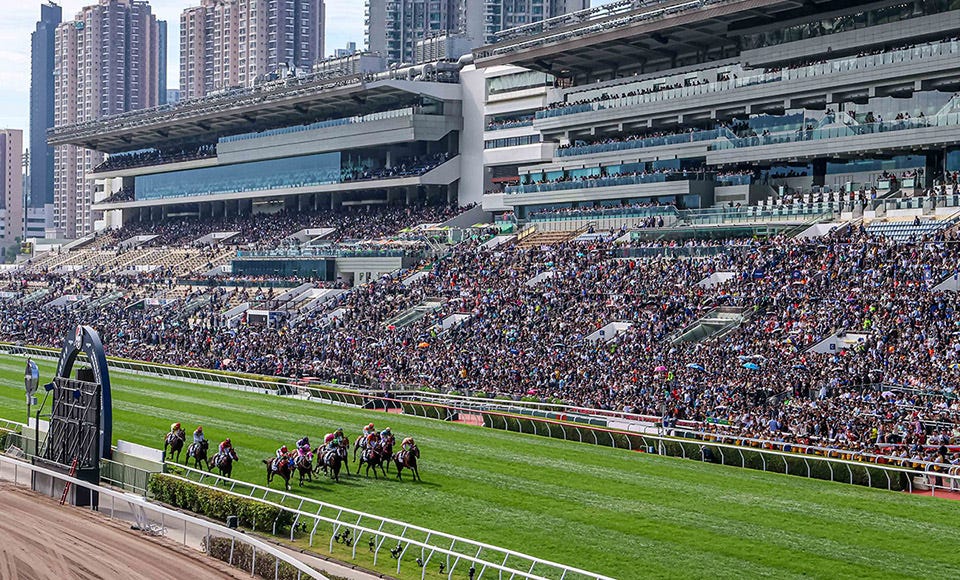
They were also at a clearing house. Across the 2025/26 season the Hong Kong Jockey Club took HK$143.31 billion — about US$18.3 billion — on eighty-eight meetings and 865 races, up 3.2 percent: the largest racing wagering operation in the world. A record HK$34.4 billion of it arrived from overseas, commingled into Hong Kong’s pools by more than sixty partners in twenty-six countries.
On none of those races did the house take a side.
Horse racing is the fourth-largest betting market on the planet, well over $125 billion a year. Across much of the world it is bet pari-mutuel: every dollar on a race goes into one pool, the operator takes a fixed percentage off the top, and the rest is divided among whoever was right. Nobody sets the odds. They are whatever the crowd’s money says when the gates open.
That is an exchange. The house is not your counterparty, cannot lose on the result, and has no reason to limit a winner, because a winner is paid out of the losers’ money, not the house’s. Every advantage prediction markets now argue for in federal court — no counterparty, prices set by participants, no motive to throttle the sharp — the tote has offered since the nineteenth century.
Hong Kong shows where the modern version is heading. The pools are going global. The Jockey Club’s World Pool lets bettors in other countries put money into the same pool as Hong Kong on marquee races, and liquidity compounds. When the Hong Kong sprinter Ka Ying Rising ran in The Everest in Sydney last October, the World Pool took HK$83 million on the race, a record for the format. The Everest runs again next month.
Two details sit under the headline number.
The first: in June 2025 the government approved more overseas simulcasts, with a stated purpose — to fight illegal betting on foreign races. Simulcast turnover rose 23.5 percent. The state’s answer to the black market was to become a bigger market.
The second: the Jockey Club’s football betting reached a record HK$172.8 billion last season. The racing club now takes more on soccer than on racing. The oldest pool in the building is no longer the biggest one in it.
Racing’s future as a sport gets argued about constantly. Its future as a wagering format mostly doesn’t, because the pool is a better machine than the sport that feeds it. Plenty of institutions end up there — the format outlives the content. The auction house outlasts every painting that passes through it. The exchange outlives the companies listed on it.
The cost is the quiet kind. A sport whose reason to exist has become the betting on it has to keep the pools full, and the pools are only full if the races keep coming, meeting after meeting, whether or not anyone would watch them otherwise.
The house at the racetrack never takes a side. It never needed to. It owns the pool.