


Records in sports usually fall in spectacular fashion.
A buzzer-beater.
A 70-point eruption.
A once-in-a-generation performance that rewrites the record book in a single night.
But some records fall differently.
Quietly.
Methodically.
One possession at a time.
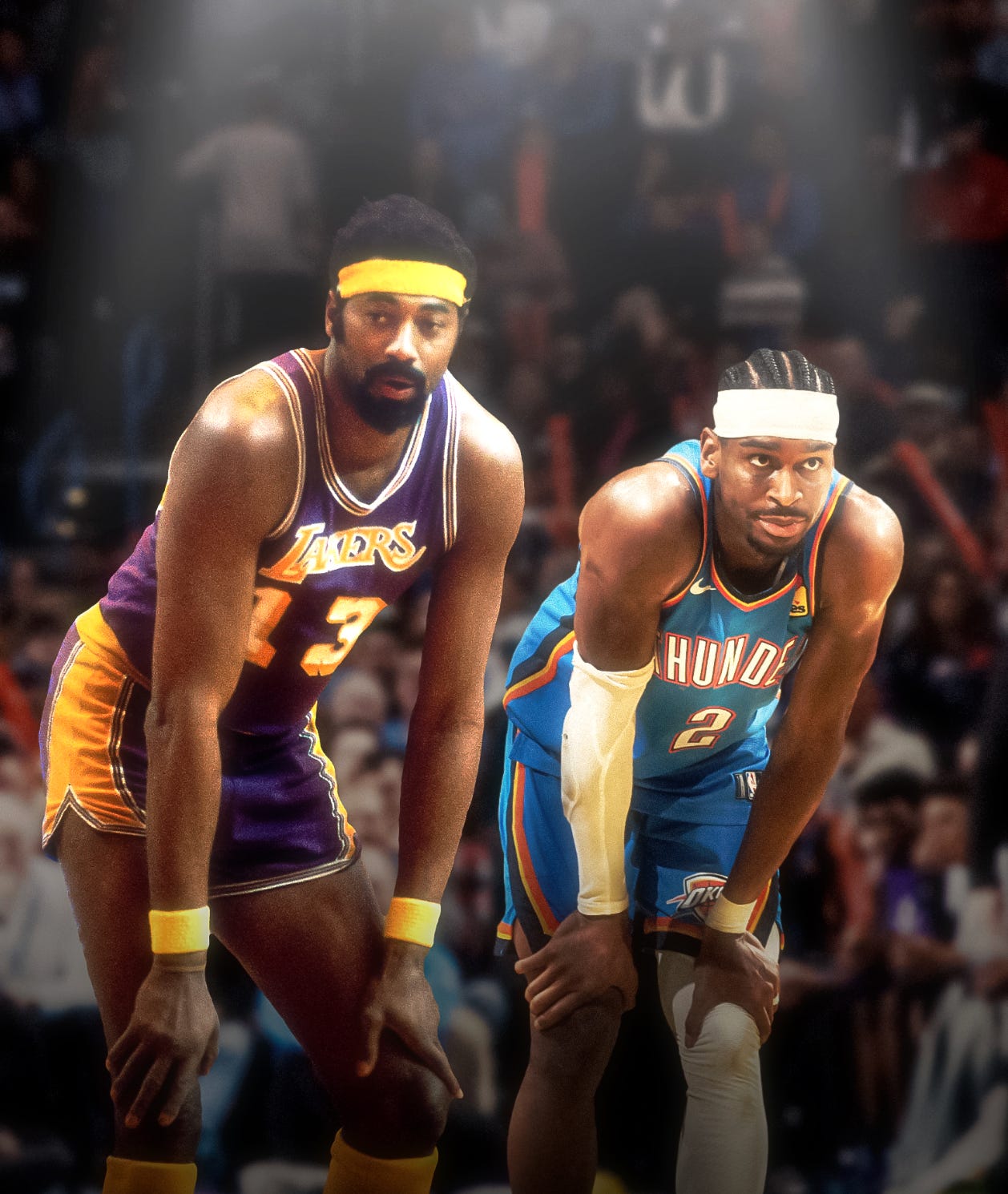
Shai Gilgeous-Alexander’s run of 127 consecutive games scoring 20 or more points is one of those records.
It did not arrive with a singular explosion.
It arrived through something far more difficult.
Consistency.
And that is precisely why it matters.
Because in the modern NBA — an era obsessed with analytics, efficiency, and optimization — consistency may be the most valuable statistical asset of all.
A Record That Survived Six Decades
The mark Shai surpassed belonged to one of the most mythic statistical forces in sports history.
Wilt Chamberlain.
For 63 years, Chamberlain’s run of 126 straight games scoring 20 or more points stood untouched.
That record emerged from a completely different era of basketball.
The early 1960s NBA was defined by:
blistering pace
extreme usage rates
limited defensive schemes
a smaller league with fewer teams
Wilt averaged over 50 points per game in one season.
He once scored 100 in a single night.
His statistical output exists in a realm that still feels almost fictional.
Yet even within that context, the streak held.
Through the Jordan era.
Through Kobe.
Through Durant.
Through the modern scoring boom.
Until now.
Why This Record Is Different
At first glance, a 20-point streak may not sound extraordinary in today’s NBA.
Scoring is up.
Possessions are up.
Three-point shooting has exploded.
But the true significance of the record lies not in the point total.
It lies in the absence of failure.
To reach 127 consecutive games, a player must avoid:
off nights
injuries
foul trouble
defensive traps
poor shooting variance
rotational rest
Every game becomes a probability test.
And probability almost always wins.
The Probability Problem
Scoring 20 points in a single NBA game is achievable for elite players.
Doing it 127 times in a row is a different mathematical problem entirely.
Even if we assume a superstar has an 85% chance of scoring 20 or more in any given game — which is extremely generous — the probability of sustaining that outcome over 127 games becomes microscopic.
The math works like this:
0.85^127
That equals roughly one chance in millions.
And that assumes the player never gets injured, never rests, never faces catastrophic defensive attention, and never simply has an off shooting night.
But real basketball contains far more noise than a clean probability model.
Which makes the streak even more extraordinary.
The Efficiency Era
There is another reason this achievement feels uniquely modern.
Shai did not accomplish it through sheer volume.
He accomplished it through efficiency.
Wilt dominated through overwhelming physical force and usage.
Modern scorers operate differently.
Today’s offensive systems prioritize:
shot quality
spacing
free-throw generation
efficiency metrics like True Shooting Percentage
Gilgeous-Alexander is one of the league’s most efficient high-volume scorers.
His game is built on:
mid-range precision
relentless rim pressure
elite foul drawing
measured pace
Where previous eras produced scoring explosions, the modern era produces sustained offensive output.
Shai’s streak reflects that shift.
It is not the product of chaos.
It is the product of control.
The Art of the Reliable Bucket
Consistency in scoring is harder than peak scoring.
Anyone can have a hot night.
But sustaining offensive production requires a deeper mastery of the game.
Players who score reliably possess three rare traits:
Shot creation — the ability to generate offense regardless of defensive structure.
Shot diversity — scoring from multiple areas of the floor.
Shot discipline — avoiding inefficient possessions.
Shai embodies all three.
His pace is deceptive.
His footwork creates angles defenders struggle to predict.
His ability to draw fouls converts pressure into points even when shots don’t fall.
In many ways, his scoring profile resembles something closer to surgical precision than explosive scoring.
Which is exactly what long streaks demand.
Why Nobody Else Came Close
The most revealing statistic may not be Shai’s record.
It’s the gap behind him.
Before this streak, the next longest run of 20-point games in NBA history belonged to Oscar Robertson at 79 games.
Kevin Durant and Michael Jordan reached 72 games.
That gap is enormous.
It suggests that scoring consistency at this scale requires a rare convergence of factors:
elite scoring skill
elite durability
elite offensive system
elite shot selection
Most superstars can sustain two or three of these qualities.
Very few sustain all four for multiple seasons.
The Modern Scoring Machine
There is also a broader context behind this moment.
Modern basketball is more analytically optimized than ever before.
Teams track:
shot locations
efficiency zones
defensive coverages
player fatigue
possession value
Offensive systems are now designed to maximize expected points on nearly every trip down the floor.
Players like Gilgeous-Alexander thrive inside these environments.
They understand spacing.
They understand angles.
They understand where efficient offense lives.
This does not make scoring easier.
It makes scoring more repeatable.
Which is exactly what long streaks require.
The Wilt Comparison
Comparing Shai and Wilt reveals something deeper about the evolution of basketball.
Wilt represented dominance.
Shai represents precision.
Wilt overwhelmed the system.
Shai operates perfectly within it.
Both approaches produced historic numbers.
But they reflect two different eras of the game.
One defined by physical supremacy.
The other defined by strategic clarity.
The Ledger’s Verdict
Records often celebrate extremes.
The fastest.
The highest.
The most in a single night.
But the hardest records to break are usually the quiet ones.
The ones built on repetition.
The ones that demand excellence not once, but every night.
Shai Gilgeous-Alexander’s streak is one of those records.
It represents the collision of talent, discipline, and modern offensive design.
And it serves as a reminder that in the data-driven era of basketball, greatness is no longer just measured in explosions.
Sometimes it is measured in the ability to show up, produce, and repeat the process.
Game after game.
Possession after possession.
For 127 straight nights.
THE LEDGER
A curated editorial series documenting the people, plays, and patterns that shaped the game.
Powered by the systems thinking behind BOHE.