


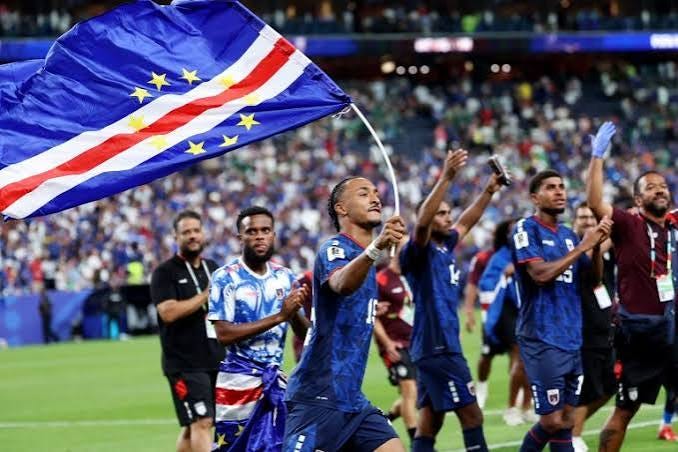
Cape Verde will walk out against Argentina carrying a story that would have sounded like a novelty a month ago and now feels like the most natural thing in the world.
A small Atlantic nation, at its first World Cup, in the knockout stage, facing the defending champions. Lionel Messi on one side. A country that most casual viewers could not locate on a map before this tournament on the other.
The old language for this would have been “fairytale.”
That word is getting too small.
Fairytales are accidents. They are gifts from the football gods. They arrive out of nowhere, briefly embarrass the established order, then disappear politely before the semi-finals so the serious nations can get back to business.
But what is happening at this World Cup does not feel accidental.
It feels structural.
The 48-team format has its critics, and some of them are right. The group-stage permutations can be clumsy. The best-third-place system is awkward. The bracket has too many moving parts and too few intuitively clean pathways. Even the tournament-design literature has pointed out the complicated incentives created by a 32-team knockout bracket fed by twelve groups of four.
But the format has also done something valuable.
It has widened the door long enough for more of world football to walk through it.
The old World Cup was built around scarcity. Thirty-two teams. A compressed group stage. One bad night and a smaller football country could spend four years waiting to explain why it was better than the result. The new tournament gives more teams a chance to remain visible. It gives them another match, another point, another tactical problem to solve, another opportunity to prove that they are not simply here to make up the numbers.
That matters because the gap is closing.
Not disappearing. Closing.
The giants still have the biggest budgets, deepest squads, most advanced domestic leagues, strongest academies, highest-profile coaches and most market confidence. France is still France. Argentina is still Argentina. Brazil is still Brazil. Spain is still Spain. Germany can still walk into a tournament with the force of history behind it.
But knockout football has never been a pure test of hierarchy. It is a short-form test of nerve, organisation, set pieces, athleticism, tactical patience and the ability to make a better team feel the weight of being expected to win.
And the rest of the world is getting much better at those things.
Africa’s performance in this tournament is the clearest evidence. Nine of ten African entrants reached the Round of 32, an unprecedented return built on years of investment in youth pathways, coaching, infrastructure and a far more global player base. Morocco’s semifinal run in Qatar was once treated as an extraordinary disruption. This tournament suggests it may have been a preview.
There is a difference between a surprise and a trend.
A surprise makes people clap.
A trend makes people adjust.
Cape Verde qualifying for the knockouts is not merely a charming story about a small country having a big month. DR Congo reaching the knockout stage for the first time, 52 years after the humiliation of its 1974 tournament as Zaire, is not merely historical symmetry. Colombia topping a difficult group. Ecuador making Germany uncomfortable. Morocco again looking like a team that belongs in any conversation. These are not random glitches in the system. They are the system telling us it has changed.
Football is more connected than it has ever been.
Players from smaller nations are not developing in isolation anymore. They are training in elite environments, playing in stronger leagues, learning under coaches shaped by different football cultures, studying opponents through the same video and data systems as everyone else, and returning to national teams with a level of tactical fluency that did not exist thirty years ago.
The old model was simple: a few countries owned the technical knowledge, the best coaching, the deepest pathways and the right to be taken seriously. Everyone else hoped for a good draw and a generous referee.
That model is breaking.
The player is faster now. Stronger now. More technically complete. The game is better distributed. A fullback from a traditionally smaller football nation may play every week against Champions League-level attackers. A midfielder may arrive from a European academy with the pressing triggers, positional discipline and confidence to match anyone for an hour. A national team that once relied on one great player can now build a system around ten competent ones.
That is how a fairytale becomes structural.
It is also why the expanded format is not merely a commercial decision, even if it was certainly one. More places mean more countries have a reason to invest. More countries in the tournament mean more players see a route. More exposure means more infrastructure, more sponsorship, more youth development, more tactical exchange, more belief that a national team can be more than a once-every-four-years cameo.
The larger format gives football’s middle class more oxygen.
That does not guarantee quality. It does not make every mismatch compelling. It does not erase the truth that some teams remain far ahead of others. But it does make the tournament more honest about where the game is heading.
The traditional powers no longer own the building.
They still own the penthouse.
That is an important distinction.
The modern World Cup is less about whether a smaller nation can beat a giant once. We have known that answer for decades. Cameroon beat Argentina in 1990. Senegal beat France in 2002. Greece won Euro 2004. Croatia reached a World Cup final. Morocco reached a semifinal. The individual upset has never been impossible.
The new question is whether smaller and less traditional nations can sustain belief over a full tournament.
Can they manage the group stage? Can they adapt to different opponents? Can they survive the pressure of knockout football? Can they build enough squad depth to handle injuries, suspensions and fatigue? Can they stop being a one-match problem and become a four-match problem?
That is where the 48-team format becomes interesting.
A bigger bracket gives a team like Cape Verde more than one chance to announce itself. It gives a Colombia or Ecuador more room to turn a strong group stage into a real run. It gives African sides a chance to meet each other, avoid each other, build confidence, collect evidence, and reach the sort of tournament temperature where a favourite begins to feel the room turning against it.
A fairytale needs time.
The old format often gave the underdog one clean act. The new format gives it a second chapter.
That is why Argentina-Cape Verde matters beyond the obvious romance of the fixture. Argentina should be the favourite. It has the talent, the pedigree, the depth, the tournament experience and Messi’s gravitational pull. But Cape Verde does not arrive as a novelty anymore. It arrives as a team that has earned the right to make the favourite uncomfortable.
That is a different kind of football story.
It is not “can the little team keep this respectable?”
It is “how long can the giant live with the possibility that this game will become strange?”
That possibility is the currency of the modern knockout tournament.
It is why Greece 2004 still matters. Greece did not play beautiful football in the conventional sense. It played tournament football. It understood that a major championship is not a referendum on who looks best over nine months. It is a series of high-pressure negotiations. It knew how to make better teams feel awkward, then anxious, then desperate.
Morocco did something similar in 2022, but with more athleticism, more defensive intelligence, more global talent and a deeper cultural charge. Argentina’s rugby run at the 2023 World Cup carried the same lesson: the old powers remain dangerous, but they no longer arrive unchallenged by default. The smaller nations are not asking for access to the conversation. They are bringing their own evidence.
World sport is getting closer together because expertise is travelling.
The best leagues are more open. The academy systems are more visible. The player pathways are more international. The tactical language is shared. The conditioning is better. The footage is everywhere. The old geographic monopolies on preparation, knowledge and confidence have weakened.
The result is not parity.
Parity is a fantasy.
The result is proximity.
And proximity is enough to create fear.
The favourite does not need to be worse than the underdog for the underdog to matter. It only needs the gap to be narrow enough that one excellent game, one inspired goalkeeper, one clean set-piece routine, one refereeing moment, one wave of national belief can close it.
That is what the World Cup has always promised.
The difference now is that more teams arrive genuinely capable of collecting on it.
The format has widened the door. The teams walking through it are better than the old football order expected them to be.
The fairytale is no longer a random interruption to the tournament.
It is becoming part of the tournament’s design.