


You know the arithmetic. Nobody taught it to you. Nobody asks you to do it. You do it anyway, around eleven at night, with the lights off.
If they win out, and the one ahead drops two of four, and the tiebreaker holds on conference record — that’s the last seed. You are not calculating anything. You are pushing a number back and forth across a ledger in your head, and every Sunday it moves a half game one way or the other, and every Monday you check. There is no version of you that doesn’t check. The checking is the whole relationship.
We are a species that cannot stop counting outs. It is the job you haven’t been rejected from yet. The scan that came back unchanged. The offer still sitting in a folder, technically alive. The counting is not stupidity. The counting is the point. It is what keeps anyone in the hunt long enough for there to be a hunt.
So let’s do the honest thing first and admit the chance is real.
In the history of professional football there have been 2,655 games in which a team led by twenty-five points or more. Those teams went 2,647-6-2. Six comebacks. Ever. A base rate of 0.22 percent — and the sixth one happened in a Super Bowl, in front of everybody, and every person reading this can name it. Not a fairy tale. A documented event with a denominator, sitting in the record like a door somebody left open.
That is what makes the counting rational. Zero and 0.22 percent are different in a way that matters enormously to a person and not at all to a spreadsheet.
Now the part nobody tells you at eleven at night.
February 1990, Tokyo. Buster Douglas knocks out Mike Tyson, and the number attached to it ever since is 42-1. Everybody knows the 42-1. It’s the title of the documentary.
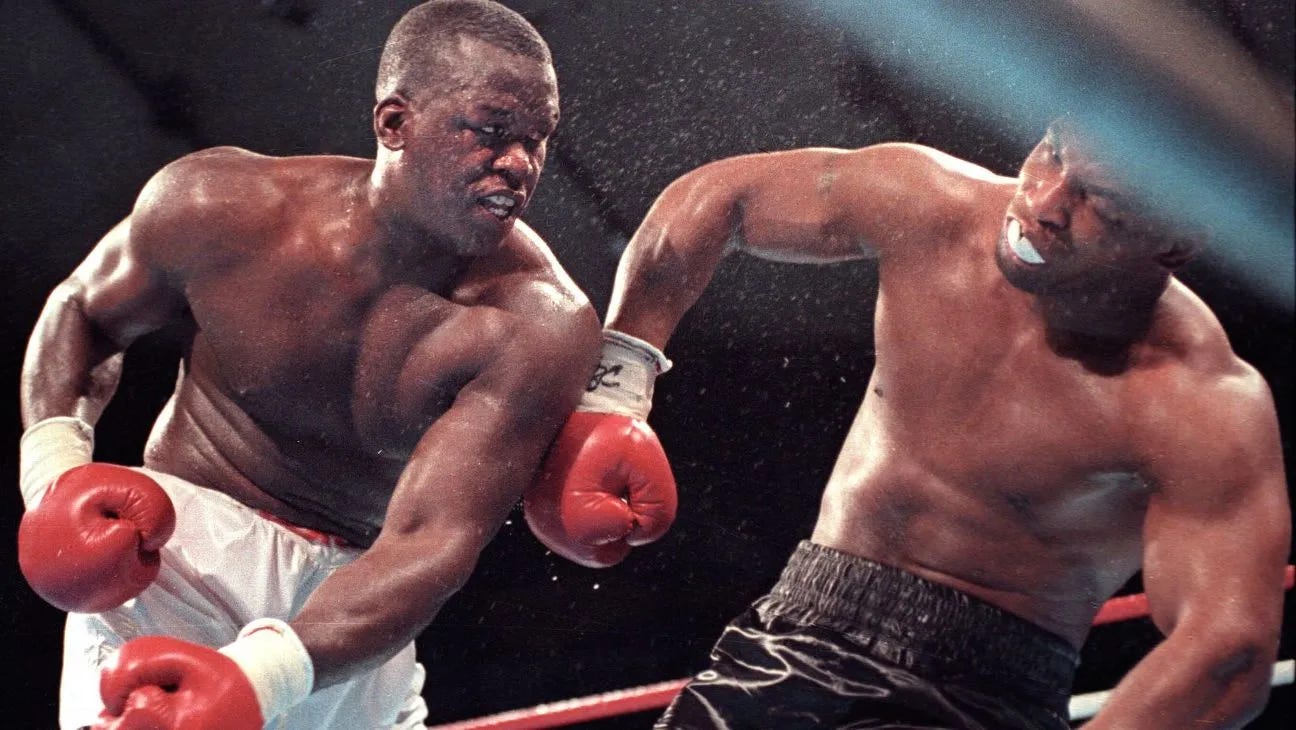
Jimmy Vaccaro at the Mirage was the only bookmaker in Vegas who hung the fight. He opened Douglas at 27-1 and moved him out as Tyson money buried the book. The widest Douglas ever reached was 37-1. The biggest single ticket on him was a thousand dollars, returning thirty-seven.
Forty-two and thirty-seven were never competing estimates of the same event. They are two sides of one market. Thirty-seven to one is what you got backing Douglas — plus-3700. Forty-two to one on is what you laid backing Tyson — minus-4200, forty-two thousand risked to win a thousand. The gap between the price you can back at and the price you can lay at is where every bookmaker who ever lived does his living. Bid and ask. That’s the entire trade.
Run the implieds and the book was nearly fair. Douglas 2.63 percent. Tyson 97.67. A hundred and three tenths, which is three tenths of a point of margin — on paper one of the tightest two-way markets Las Vegas ever hung.
The Mirage still made roughly $104,000 on it.
The profit was never in the margin. It was in the shape of the money. Vaccaro took $54,000 on Tyson to win $2,000. He took $93,000 to win $3,000. Against that he took thousands of Douglas tickets at five and ten and twenty dollars, and one man for a thousand. Favorites get bet in bricks. Longshots get bet in coins. So when the right hand landed in the tenth, the book wasn’t ambushed. It was paid — and balanced such that a Tyson win would have returned only modest profit.
Read that again. The one house in Las Vegas willing to hang the fight was quietly rooting for the greatest upset in boxing history.
The mechanism is not a conspiracy. It’s published, and every professional reading this has priced it a thousand times. A standard NFL spread runs a hold under five percent. Championship futures run twenty to thirty. Take a real book: the 2022 Super Bowl market at DraftKings summed to 121.76 percent, a hold of 17.87. A team posted at 11.76 percent implied was actually 8.84 once you de-vig it. A third of the value gone before a snap.
That’s the toll on the whole market. The longshot pays more, and it has been measured to death. The longshot pays more, and it has been measured to death. Thaler and Ziemba filed it as an anomaly in 1988 and it has survived every attempt to explain it away since.
Snowberg and Wolfers ran 6.4 million American horse race starts between 1992 and 2001. Betting the favorite in every race loses 5.5 percent. Betting at random loses 23. Betting anything at 100-1 or longer loses 61. Whelan found the identical gradient in 2024 across 56,004 professional tennis matches — losses climbing steadily as implied probability falls, steepest at the extremes, bettors roughly breaking even around ninety percent.
The shape is not a quirk of one sport or one decade. The further out you walk toward the miracle, the more it costs to stand there. Eleven times more, at the end of the board, than backing the thing that was always going to happen.
So the chance is real, and the chance is the highest-margin item in the shop, priced that way because the operator layer knows exactly what you are buying. You are not buying a team. You are buying the right to keep counting. That has a market rate, quoted daily, and it is the worst number on the board.
Nobody files the thing that went their way under luck. We reverse-engineer inevitability from comfortable margins, in football and in our own lives.
The structure is crueler still. The sport has been engineered to prevent the thing you are waiting for.
A hard cap, a draft that rewards failure, revenue sharing, thirty-two teams — all of it deliberately compresses the distribution. Parity makes everyone plausible, and plausibility is the enemy of the miracle. Leicester required a league with brutal, unregulated inequality. The NFL sells competitive balance, and the price of competitive balance is that nothing genuinely impossible ever happens in it.
What the league produces instead is a reliable supply of moderate improbability — a 60-1 champion every few years. It feels like chaos. It is a very well-managed distribution.
None of which will stop you tonight. Six teams did it in two thousand six hundred and fifty-five tries. Six is not none.
That’s the only number the house has ever needed you to know.