


Two days before the first Test, the South African broadcaster put out a promo on X. Three Tests, the world champions at home, the top two sides in the game. The line across the top read: our cameras will be sharp.
A camera emoji. No further explanation offered, because none was needed.
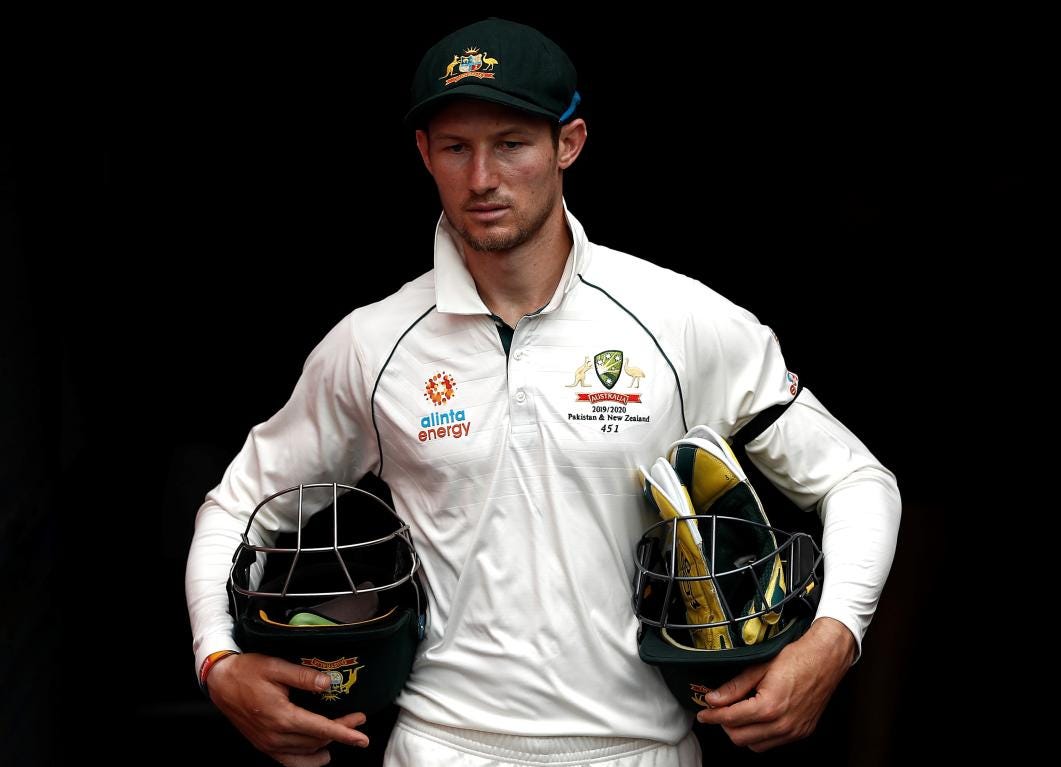
SuperSport is the network whose cameras caught Cameron Bancroft at Newlands in 2018. Eight years on it is selling that capability as the attraction — come for the cricket, stay for the surveillance. It is a good joke. It is also, without anybody intending it, the most honest statement anyone has made about this rivalry, because the camera is the only thing in this entire story that has ever actually worked.
Begin where it started, which is further back than most people take it.
In the summer of 1969-70, South Africa played Australia at home in a four-Test series and won all four. Graeme Pollock made 517 runs. Mike Procter took 26 wickets. A twenty-four-year-old named Barry Richards walked out for his first Test and made a hundred. The captain was Ali Bacher. Remember that name.
The last of those Tests finished on 5 March 1970, and then South Africa did not play another one for twenty-two years.
What came back in 1992 was a side assembled out of a long silence. Peter Kirsten made his Test debut aged 36 years and 340 days, having spent the best decade of his career playing nineteen unofficial Tests that the record books do not count. He played twelve real ones. His half-brother Gary played 101. In March of that year, in Brisbane, Jonty Rhodes picked up a ball at backward point, ran at the stumps with Inzamam-ul-Haq stranded, and threw himself the final two metres rather than lose the half-second it would have cost to stop and aim — a photograph before it was a dismissal.
Then Sydney, January 1994. Australia needed 117 in the fourth innings and were 63 for four overnight. On the final morning Fanie de Villiers bowled 23.3 overs, eight of them maidens, and took six for 43. Australia were bowled out for 111. Glenn McGrath was last out at 12.57 in the afternoon. South Africa won by five runs.
If you were a kid in Australia across those summers you did not need anyone to explain what you were watching. Donald steaming in with that high, cruel action. Kallis, who would end up with more than 13,000 Test runs and nearly 300 wickets and somehow never quite got talked about the way the numbers deserved. Rhodes in the covers, turning fielding from a chore into a reason to watch.
And Cronje. Big, severe, red-haired, utterly in command. The captain who looked like he had been carved for the job.
That is the thing worth holding onto before any of what follows. The cricket was real. It has not been retrospectively cancelled by what came later. Six for 43 on the last morning at the SCG is still six for 43 on the last morning at the SCG.
On 7 April 2000, the Crime Branch of the Delhi Police went public with a tape.
Pay attention to how that happened, because it is the whole argument. The Delhi Police were not investigating cricket. They were working an extortion complaint — a man named Rama Kant Gupta had reported threatening calls. Call-detail records led to other numbers, those numbers went under surveillance, and the officers listening to them discovered that one of the voices belonged to the captain of the South African cricket team, talking to a bookmaker named Sanjeev Chawla.
Nobody was looking for Hansie Cronje. He simply fell into a net that had been cast for somebody else.
He denied it on 9 April. On 11 April he was sacked, having confessed to Ali Bacher — the same Ali Bacher who had captained the side in 1970, now running the game in South Africa, thirty years and one wilderness later — that he had “not been entirely honest.” He admitted ten to fifteen thousand American dollars. By June, under oath at the King Commission, the number was around a hundred thousand, and he explained himself in six words that have outlived everything else he ever said: the unfortunate love I have for money.
At Nagpur on 19 March he had offered Herschelle Gibbs fifteen thousand dollars to score fewer than twenty. Gibbs made 74 off 53. He offered Henry Williams fifteen thousand to go for runs; Williams broke down injured after 1.5 overs. South Africa won by ten. Both men were banned for six months anyway, for agreeing.
But the match that actually tells you what was happening is the one everybody applauded.
Centurion, January 2000. Rain had taken days two, three and four of a dead rubber. On the final morning Cronje and Nasser Hussain agreed that each side would forfeit an innings to manufacture a result, England chased 249, Darren Gough hit the winning runs, and England won a Test in South Africa for the first time since 1965. The cricket press called it a gift to the game. It was held up for years as proof that two captains could put the sport above the scoreboard.
The idea was not Cronje’s. It belonged to a bookmaker named Marlon Aronstam, who had come to his hotel room and proposed it, offering five hundred thousand rand to a charity of Cronje’s choosing. When Hussain agreed on that last morning, Cronje sent Aronstam a text message: the game is on.
After the match Aronstam handed him fifty thousand rand in cash over two days, and a leather jacket for his wife. The charity money was never paid and was never mentioned again.
And here is the part that matters more than the money, because it explains the mechanism rather than the man. Cronje was not paid to lose. Rain had made a draw close to certain, the books were heavily exposed on the draw, and his instruction was simply to make sure somebody won. Either side. The result was genuine, the cricket was real, both teams tried, and the entire thing had been bought in a hotel room beforehand.
Hussain, years later: “There was so much money on the draw, he was told to get a result.” Mark Butcher, who batted in it: “It was false, it was fake.”
That is what a bought match actually looks like. Not a dropped catch. A gesture of sportsmanship, praised by everyone, arranged by a man with a book to balance.
Now the part Australians tend to walk past.
In September 1994, in Colombo, an Indian man calling himself John approached Mark Waugh and asked for pitch and weather information. Waugh took the money. He introduced Warne to John at the casino next to the team hotel, on a night Warne had just lost five thousand dollars at roulette; the following day John gave him five thousand dollars. Warne supplied information before three matches, including a Boxing Day Test at the MCG. Waugh received six thousand dollars, Warne five.
In February 1995 the Australian Cricket Board fined them — ten thousand dollars and eight thousand respectively — in private. The decision was taken by the chairman and the chief executive without consulting the rest of the board, which was informed only after the players had left for the West Indies. The reported reason for the secrecy was that the two men were due to give evidence against Pakistan’s Saleem Malik, and their credibility as witnesses needed protecting.
It stayed buried for almost four years, until a journalist told the board he was going to print it anyway. When Rob O’Regan QC finally reviewed it in February 1999, he found the fines inadequate and said a suspension for a significant period would have been more appropriate.
So the sequence of this rivalry is not the one people recite. It is not South Africa fell, and then years later Australia fell. It is Australia first and concealed, South Africa second and exposed by foreign police, Australia again and exposed by a television camera. And only the middle one was about betting at all.
Which brings us to Newlands, the ground where this series finishes at the end of the month.
Day three, 24 March 2018, series level. After the forty-third over the cameras found Cameron Bancroft working the ball with a small yellow object and then pushing it down the front of his trousers. The umpires did not change the ball or award penalty runs — the condition of it was not judged to have been noticeably altered. That night Bancroft said it was tape with grit on it. Five days later his employer established it was sandpaper.
The International Cricket Council fined him seventy-five percent of a match fee and banned him for nothing at all. Cricket Australia banned him for nine months, Steve Smith and David Warner for a year each, took away roughly two and a half million dollars apiece in Indian Premier League money, and watched a naming-rights sponsor walk inside a week. The game’s own governing body thought it was worth a fine. His employer thought it was worth most of a year.
And here is the finding that nobody states plainly, so we will.
There was no money in it. No bookmaker, no payment, no betting, no outside party. Not in Cricket Australia’s investigation, not in the ICC charges, not in the Ethics Centre’s cultural review, not in the integrity unit’s follow-up when Bancroft hinted in 2021 that the bowlers must have known, not in his manager’s claim in 2022 that more people were involved. Every allegation ever made about that afternoon concerns who knew, never who paid. The standard reference work on betting controversies in cricket does not list Newlands at all.
The Ethics Centre review, published that October, found the thing exactly. It rejected “win at all costs” as too easy and replaced it with something sharper: a culture of winning without counting the costs, in which people had come to redefine some cheating as playing hard to win.
So the two scandals that define this fixture are not the same scandal. One man took money to arrange a result. Other men broke a rule in order to beat you. We have a single word for both and it has cost us twenty-six years of clear thinking.
What they share is something else entirely.
Cricket did not catch either of them. A police wiretap aimed at an extortionist caught Cronje. A television camera caught Bancroft — and the man who ran that broadcast, Alvin Naicker, said this week that it was “an absolute fluke.” An operator stayed on Bancroft. A zoom camera found the yellow object. The stadium’s big screen showed the same picture independently, and Bancroft, watching himself on it, moved the sandpaper into his trousers, which was also filmed. The third umpire asked Naicker to stop replaying it. Naicker refused.
The sport built its anti-corruption unit on 26 June 2000 — nineteen days after the King Commission had already opened. Cricket assembled its police force only after a foreign police force had done the work by accident.
So, the question. Was it bookmaking that ruined the gentleman’s game?
No. It was bookmaking that nobody could see.
The market Cronje sold into was illegal, and illegal means unregulated, and unregulated means no account records, no audit trail, no suspicious-transaction reports, no regulator to telephone. There was no mechanism anywhere in the world that would have noticed. Sir Paul Condon, who wrote the first honest account of all this in 2001, put it exactly: there was “overwhelming evidence of a significant unlawful market place for betting on all international matches,” and the Indian betting industry had been “the engine room which has powered and driven cricket corruption” — while adding, in the same paragraph, that the blame “must not be unfairly laid upon the Indian sub-continent.” He drew the distinction carefully. Almost nobody since has bothered.
The United Nations Office on Drugs and Crime puts the figure at roughly eighty percent. Four in every five sports bets placed on earth go through channels no regulator can observe. That is not a statistic about cricket. It is the weather that cricket plays in.
On Friday morning at Kingsmead, two very good sides start a series that has nothing to do with any of this. The world champions, who have won thirteen of their last fourteen Tests. The top-ranked team in the world, who lost to them at Lord’s in June of last year. Markram, who averages over sixty against Australia. Smith, with nearly eleven thousand Test runs. Rabada, if his hamstring holds.
There will be sandpaper gags in the crowd at Newlands in three weeks, and the broadcaster has already told you its cameras are sharp, and all of that is fine. It is a good joke about a bad week eight years ago.
But the cameras are not the joke. The cameras are the apparatus. They are what the game has instead of the ability to look at itself, and twice now they have been pointing in the right direction entirely by chance.
Six for 43 on the last morning at the SCG is still six for 43 on the last morning at the SCG. That part was never in doubt and never needed watching.
It is everything that happens away from the square that nobody was ever able to see.