


The first-round doubles draw at this US Open put Venus and Serena Williams — forty-six and forty-four years old, entered on a wild card — across the net from the fourteenth seeds. One of those seeds was born outside Detroit and plays for Australia.
Her name is Maya Joint. She left the American system in 2023, at seventeen, because, in her own words, she wasn’t getting the support she thought she deserved from the US federation. Tennis Australia flew her out for a funded two-week trial and gave her a base in Brisbane. In July she beat Serena Williams at Wimbledon.
So the picture in Queens this week is an American-born player wearing another country’s flag, standing opposite the two greatest players this country has ever produced, both in their forties, neither of whom qualified on merit. They were handed the draw.
That is not a nostalgia story. That is a market reporting a result.
No American man has won a major since Andy Roddick at this tournament in 2003. Twenty-three years. In that span the country produced Olympic sprint champions in bulk, an unbroken supply of gymnasts, and a football economy so deep it exports the surplus for fun. The reflexive explanation is that tennis lost its talent. It didn’t. It lost the ability to see it.
Start with the pipeline everyone assumes is the pipeline. College tennis is not shrinking — it’s thriving. It just stopped being American. Racquet ran two decades of Division I rosters, more than seventy-three thousand player-year entries: in 2005, roughly seventy percent of incoming D1 tennis freshmen were American-born. This year, under forty. That is not a decline in interest. That is an operator layer behaving exactly as designed. A coach paid to win now takes the twenty-one-year-old who has ground three years of European futures over the eighteen-year-old American, every time, and the scholarship leaves with him.
Now the part nobody says out loud. Football and track don’t develop talent so much as find it, and they find it free. Last year 1,029,588 American boys played eleven-a-side high school football and 1,158,043 boys and girls ran high school track — every one of them timed, ranked and scouted at no cost to themselves, inside a public system that exists in every county. An enormous, cheap, continuously updating sample. Outliers cannot hide in it.
High school tennis exists too — 363,388 kids played it last year. It is almost entirely irrelevant to professional tennis, because the professional pathway runs alongside it, privately, from about age eight, and does not look up. A national-level American junior costs somewhere between thirty and a hundred thousand dollars a year. A full year of tennis boarding at IMG runs $75,400 to $99,900 for 2026-27. That is the price of a look.
This is a liquidity problem dressed as a talent problem. A market with millions of cheap, observable samples prices talent efficiently and surfaces freaks. A market with a $75,000 cover charge and a few thousand participants does not discover anything — it confirms who could pay to be seen. American tennis is a thin market, and thin markets are wrong in a predictable direction. They systematically miss whoever couldn’t get in the room.
Which brings us back to the two women on the wild card, and why the headline above is not sentimental.
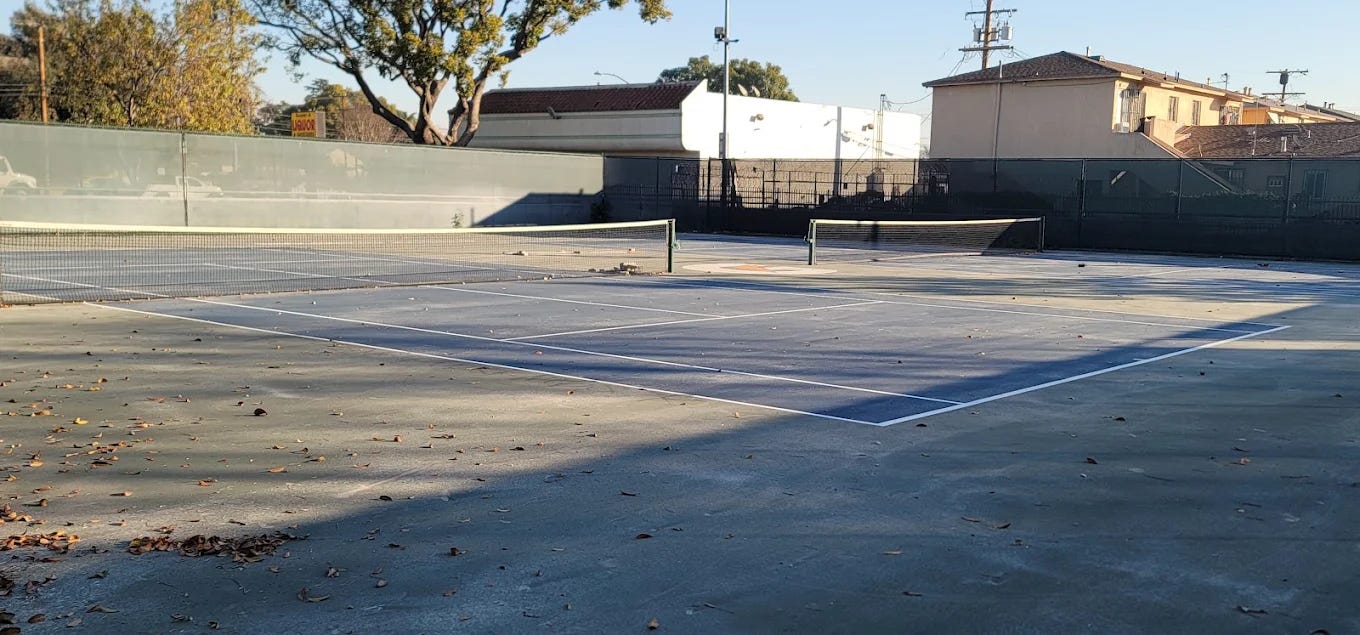
Venus and Serena Williams are the single largest anomaly in the sport’s history, and the reason is not their talent. It is where the talent was found. Public courts, a father with a plan, and none of the apparatus that now costs six figures a year. They are the sport’s own best evidence about where American players actually are. And the response, across twenty-five years of unprecedented visibility, was not to go looking in more places like that one. It was to make the funnel narrower and more expensive, and then to express surprise, every September, that nothing came out of it.
You have watched this happen somewhere with no net involved. The hiring pipeline that draws from five schools and concludes there is a talent shortage. The fund that sees only warm introductions and decides founders aren’t what they were. The complaint is always that quality fell. The truth is almost always that the search got expensive and nobody adjusted the conclusion.
The cost is not abstract, and it should be said once, plainly: it is a generation of American kids who were never watched. Not overlooked — unobserved. The country had them and could not afford to go and look.
Maya Joint is one of the few we can actually count, because she went somewhere that would pay for the trial. Most of them just stopped playing, and no federation keeps a list of those.
The market has not failed to find another Venus Williams. It simply never went back to where it found the first one.