


Bottom of the sixth at Yankee Stadium, two outs, Tampa Bay leading 4-2, the Yankees three outs from a 4-2 deficit becoming the rest of their winter.
Anthony Volpe hit it to left. George Lombard Jr. ran from first. Victor Mesa Jr. got under it at the wall and a man in the front row reached out over the field and got a hand to it first.
It was signalled a home run. For about four minutes, the game was tied.
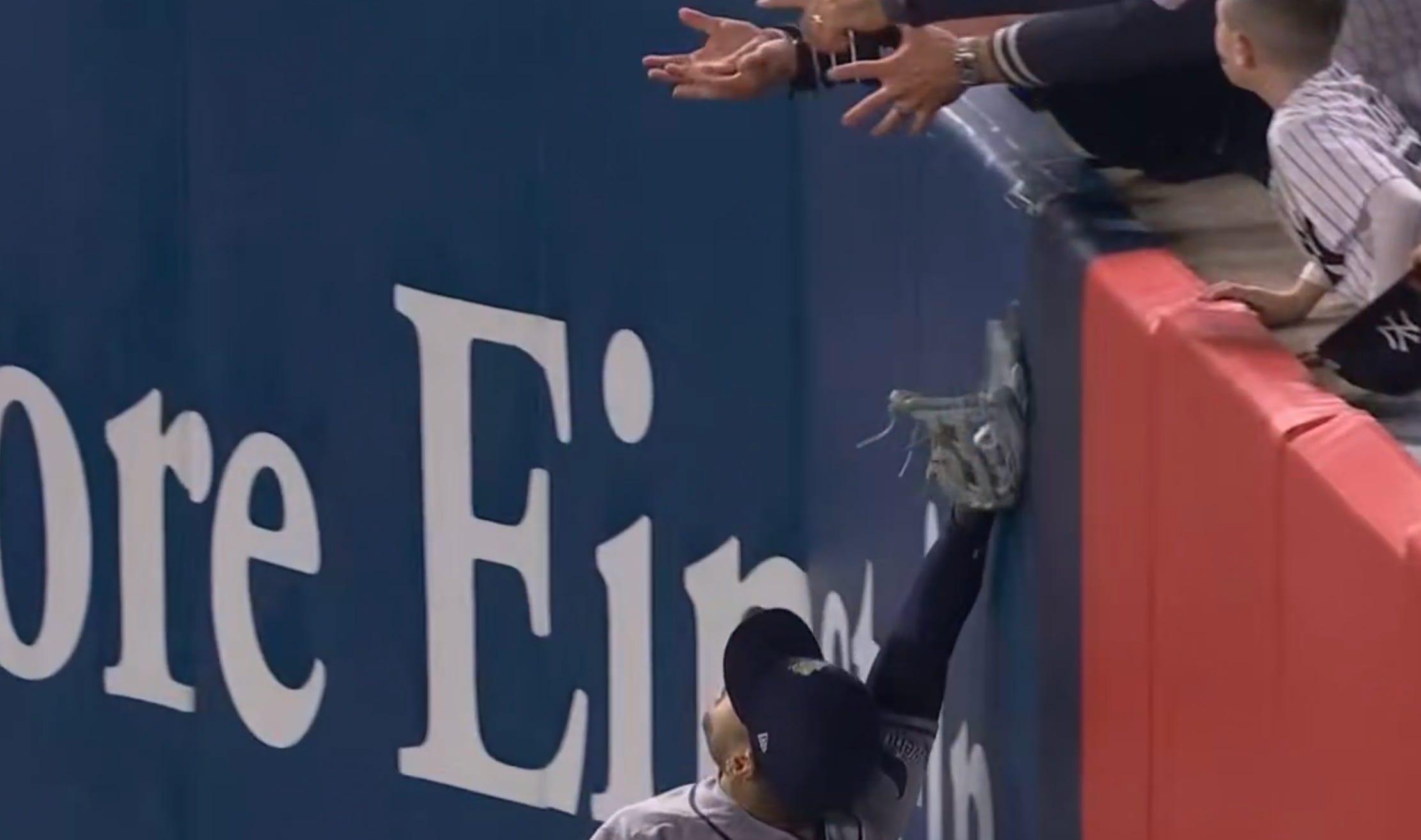
Then the Replay Center in Secaucus returned the only sentence that mattered: “The ball would not have left the playing field nor would it have been caught.” Spectator interference under Rule 6.01(e). No home run. One run in, Volpe placed at second, 4-3. Kevin Cash argued it should have been an out and lost that part. Spencer Jones struck out to strand the tying run at second, and three innings later Bryan Baker finished it.
Rays 4, Yankees 3. A sweep. Tampa Bay to the third American League Championship Series in the franchise’s history, out of a payroll that would not cover New York’s outfield.
So: what did it cost?
We modelled the two states — a Monte Carlo of the remaining game from each, league-average run environment, no automatic runner because the postseason does not use one.
With the home run: 4-4, two outs, nobody on. The Yankees are roughly a coin flip. About even money.
With the double: 4-3, two outs, runner on second. The Yankees are about 37 percent. About +165.
Call it fourteen percentage points of win probability, removed by a forearm. In price terms, a position that was worth roughly even money was worth roughly +165 four minutes later, and both numbers were live on the same play in the same minute. That is not a mistake in the market. That is the market doing exactly what it is built to do, as fast as the information arrived.
Everyone holding Yankees live had a window in which the board said one thing and the rulebook had not yet said the other. Some people cashed out inside it. Most did not. Nobody could have known which number was the real one, because for those four minutes there were genuinely two.
Here is what makes it worth more than a bad beat.
Thirty years and two days earlier, on 9 October 1996, in the eighth inning of Game 1 of the ALCS, with the Yankees trailing Baltimore by a run, Derek Jeter hit a fly ball to right field at Yankee Stadium. A twelve-year-old named Jeffrey Maier reached over the wall and knocked it into the stands. Tony Tarasco said he had it. Davey Johnson was ejected arguing. Rich Garcia ruled it a home run on the spot, and the game was tied.
Garcia watched the replay afterward and admitted he had got it wrong. It did not matter. The Orioles protested and the American League president denied it, because a judgment call cannot be protested. There was no review, because review did not exist. The Yankees won in the eleventh on a Bernie Williams home run, won the series, and won the World Series.
Same ballpark. Same month. Same gesture — a hand over a wall, in front of forty thousand people.
One fan handed the Yankees a championship. The other took their season.
The fan did not change. The apparatus did.
Which is the only part of this that is actually about money.
Baseball is the most comprehensively priced sport ever built. There is a number on the spin rate of every pitch thrown on Wednesday night. There is a number on how hard Volpe hit it and at what angle it left the bat. There is, specifically and precisely, a catch probability assigned to the ball Mesa was standing under — Statcast puts one on every fly ball hit to an outfielder, and it is accurate enough that clubs make defensive positioning decisions on it.
There is no number on the hand.
Not because anybody has been lazy. Because he cannot be modelled. He has no prior, no sample, no tendency, no platoon split. He does not appear in any dataset in any front office in the league, and he will not appear in one tomorrow. He bought a ticket, he put an arm where an arm should not go, and for four minutes a baseball game existed in two states at once.
Every projection system in the sport is an argument that the future is mostly knowable if you measure enough of the present. That argument is mostly correct, which is why the industry built on it is worth what it is worth. And then once every thirty years or so, in the same stadium, the unmeasured variable leans over the wall and settles the thing by hand.
As for what it cost the sport — the honest answer is less than the volume of noise suggests. The Yankees draw more eyes than Tampa Bay does, and television knows it. But the call was reviewed, the ruling was correct on the evidence, and the system worked exactly as designed, which is the opposite of 1996 in every respect that matters.
What it cost was something narrower and harder to invoice. It cost the Yankees a tie game in the sixth inning of an elimination night. It cost a nineteen-year-old season-ticket holder’s worth of goodwill in one section of the left-field stands. And it cost everyone who had a live position the difference between a number and the same number four minutes later.
The fan will be identified, probably already has been, and will spend some period of his life being the answer to a question. Jeffrey Maier is in his forties and still gets asked.
They built the cameras so this could never be decided by an umpire’s eyesight again, and they were right to.
The cameras still cannot stop the hand. They can only tell you, afterwards, precisely how much it was worth.