


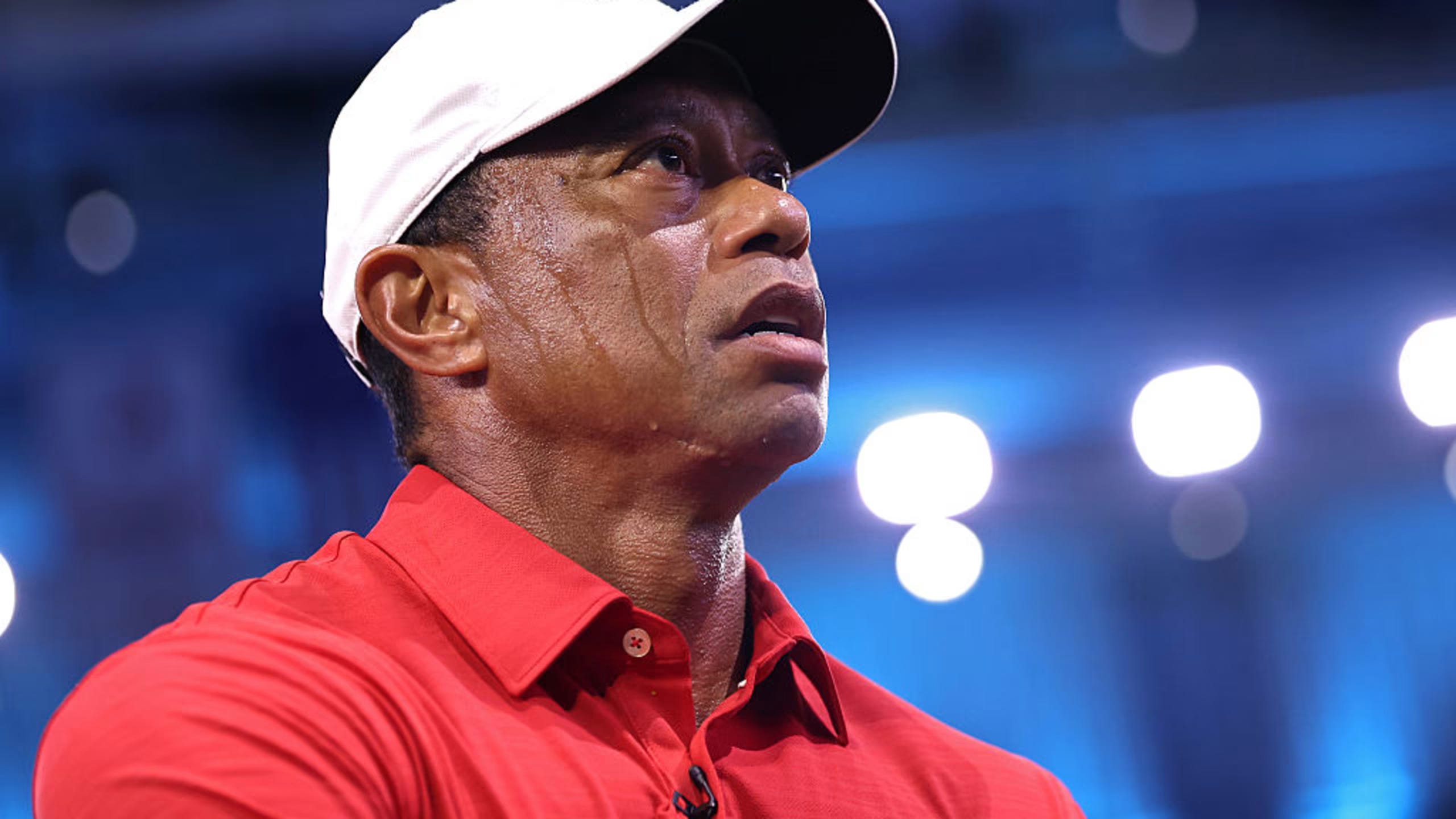
There is a version of sport that exists entirely in numbers.
It’s clean. Structured. Comforting in the way all well-built systems are. You can open a model, scan a stat sheet, track form over time, and begin to feel like you understand something about what is about to happen next. This is the version of sport we’ve grown increasingly comfortable with — the one that lives inside data, inside probability, inside the quiet belief that if we collect enough information, the future will eventually start to behave.
And then there’s Tiger Woods.
Tiger doesn’t fit inside that version of sport. He never has. Not at his peak, when he turned golf into something bordering on inevitability, and certainly not in the years that followed, when his career stopped behaving like a trajectory and started resembling something far more human — fractured, rebuilt, interrupted, and somehow still capable of moments that feel out of time.
If you built the perfect predictive model for golf — if you layered in strokes gained, course history, major performance under pressure, environmental factors, recovery curves — you could get very close to explaining the average player. You could even get close to explaining the elite.
You would not get close to explaining Tiger.
Because Tiger’s career has never been governed by averages.
It has been governed by extremes.
The version of Tiger that lives in the market is easy to understand. It’s the one we’ve all agreed to remember.
Fifteen majors.
Augusta as a personal stage.
A level of dominance that didn’t just win tournaments but bent them.
That version still exists, at least in part, in the way the world reacts to him. His name alone still carries weight. It shifts attention. It moves betting markets in ways that younger, statistically superior players cannot quite replicate. There are athletes who perform at a higher level today, but there are very few who still feel like Tiger Woods when they enter a field.
That feeling matters.
Markets, for all their sophistication, are still built on perception as much as performance.
But perception has a flaw. It freezes time.
It holds onto a version of an athlete long after the athlete himself has moved on — physically, mentally, structurally. It assumes continuity where there is none. It assumes that what was true once will, in some diluted form, remain true now.
That assumption is where things begin to break.
Because the version of Tiger that does not live in the market — the version we don’t price, don’t quantify, don’t fully acknowledge — is the one that actually determines what happens next.
It’s the body that has been rebuilt more times than we can count, each time returning slightly different, slightly less forgiving. It’s the accumulation of surgeries that don’t just repair damage but alter movement, timing, feel — the invisible mechanics that separate elite golfers from everyone else. It’s the reality that pain, when it becomes constant, is no longer an event but a condition.
And beyond the physical, there is the part of Tiger’s story that has always resisted clean framing.
The scrutiny.
The collapse.
The years spent being dissected not as an athlete, but as a person.
We talk about form as if it exists in isolation, as if a swing can be separated from the life that surrounds it. But no athlete — not even one as singular as Tiger — exists in that vacuum.
This is where the betting conversation becomes uncomfortable.
Because betting, at its core, is an exercise in constructing certainty from incomplete information. We take what we can measure — performance data, historical trends, recent results — and we build a framework that allows us to assign probability. It’s a rational process. It works, more often than not.
But it only works within the boundaries of what is visible.
Tiger exists outside those boundaries.
His career is not a line that can be projected forward. It is a series of interruptions — dominance followed by absence, control followed by collapse, resurgence followed by uncertainty. Every time the system tries to anchor to a version of him, he resets the terms.
Not because the data is flawed.
Because the data is incomplete.
And this is the part that rarely makes it into the model.
The human element is not a small variable. It is the largest one.
It is the difference between a player who looks ready on paper and one who actually performs. It is the space between expectation and reality, between what should happen and what does. It is the quiet, unquantifiable layer that sits beneath every swing, every decision, every outcome.
We don’t ignore it because it’s unimportant.
We ignore it because it’s difficult.
Tiger Woods forces that difficulty into the open.
He reminds us that greatness is not a stable state. It is a peak sustained by trade-offs — physical, mental, personal — that don’t always reveal themselves immediately. He reminds us that the cost of becoming inevitable is often paid later, in ways that cannot be reversed, only managed.
And most importantly, he reminds us that no matter how advanced our systems become, they will always be limited by what they can see.
Because behind every stat line is a life.
Behind every performance is context.
And behind every athlete we try to price is a version of the story we will never fully know.
The instinct is to believe that more data will solve this. That if we just collect enough, refine enough, model enough, we will eventually close the gap.
Tiger is the proof that we won’t.
There will always be something missing.
Something personal.
Something physical.
Something human.
And that’s not a flaw in the system. It’s the point.
The Ledger’s Verdict
We build models to reduce uncertainty.
Tiger Woods exists to remind us that uncertainty is never going away.
The edge isn’t just in the numbers.
It’s in understanding where they stop.
And no athlete has ever made that boundary more visible than Tiger Woods.