


There is a small plastic sign on blackjack tables in casinos all over the world. It says NO MID-SHOE ENTRY. Four words, laminated, screwed to the felt.
That sign is a man’s name, written as a prohibition.
His name is John Ferguson. He has a PhD in finance from Stanford, he taught the subject at San Francisco State, and at the end he negotiated to teach his final term for a dollar so he could stop attending faculty meetings and go play cards. In 1975 he published Professional Blackjack under the pen name Stanford Wong, and in it he explained back-counting: stand behind a table, say nothing, wait for the count to turn, sit down only when the deck owes you money. It worked. The technique is called wonging, after him.
The casinos read the book. They did not ban the count and they did not throw out the mathematics. They put up a sign that said you cannot sit down in the middle of a shoe, and the edge went quietly into a drawer.
Twenty-six years later he did it again.
Sharp Sports Betting came out in September 2001. Three hundred and eighty pages of parlays, teasers, money lines and props, and buried in it the thing that would carry his name into a second sport. The six-point teaser. What everyone now calls the Wong teaser.
Here is why six and not five, and not seven.
Football does not distribute its results evenly. It clusters, because the scoring instruments are lumpy — three for a field goal, seven for a touchdown and the kick after it. Three is the most common margin of victory in the NFL. Seven is second. Together they account for something like a quarter to a third of every game ever finished. They are not numbers. They are gravity wells.
A teaser lets you move the line in your favor and get paid less for the privilege. Move it four points and you cross nothing that matters. Move it seven and you have paid for ground you did not need. Six is the only move that walks a favorite from -8.5 down through seven and through three to -2.5, or a dog from +1.5 up through three and through seven to +7.5. One adjustment, both wells, and you are now betting on the two most crowded outcomes in the sport.
Legs that qualified hit at roughly 76 percent.
At the pricing that existed then — a two-team six-point teaser at -110 — you needed 72.4 percent per leg to break even. That is not a small gap. That is a published, replicable, three-and-a-half point edge, sitting in a paperback that cost about twenty dollars, available to anyone who walked into a bookstore.
It worked for twenty years.
Now go and look at the price. A standard two-team six-point teaser at the major regulated books runs -130 to -135. Run the arithmetic and the break-even climbs to 75.2 percent at -130, and 75.8 at -135.
Hold the historical hit rate steady at 76.1 and the whole thing collapses in your hands. At -110 you were earning better than ten percent on money risked. At -130 you are earning 2.5. At -135 you are earning eight tenths of one percent, which is not an edge, it is a rounding error with a spreadsheet attached.
And run it at the bottom of the historical range instead — 75 percent, still perfectly plausible — and -130 is already losing. Minus 0.48 percent. At -135, minus 2.08.
The strategy’s own documented performance now straddles break-even. That is the ballgame.
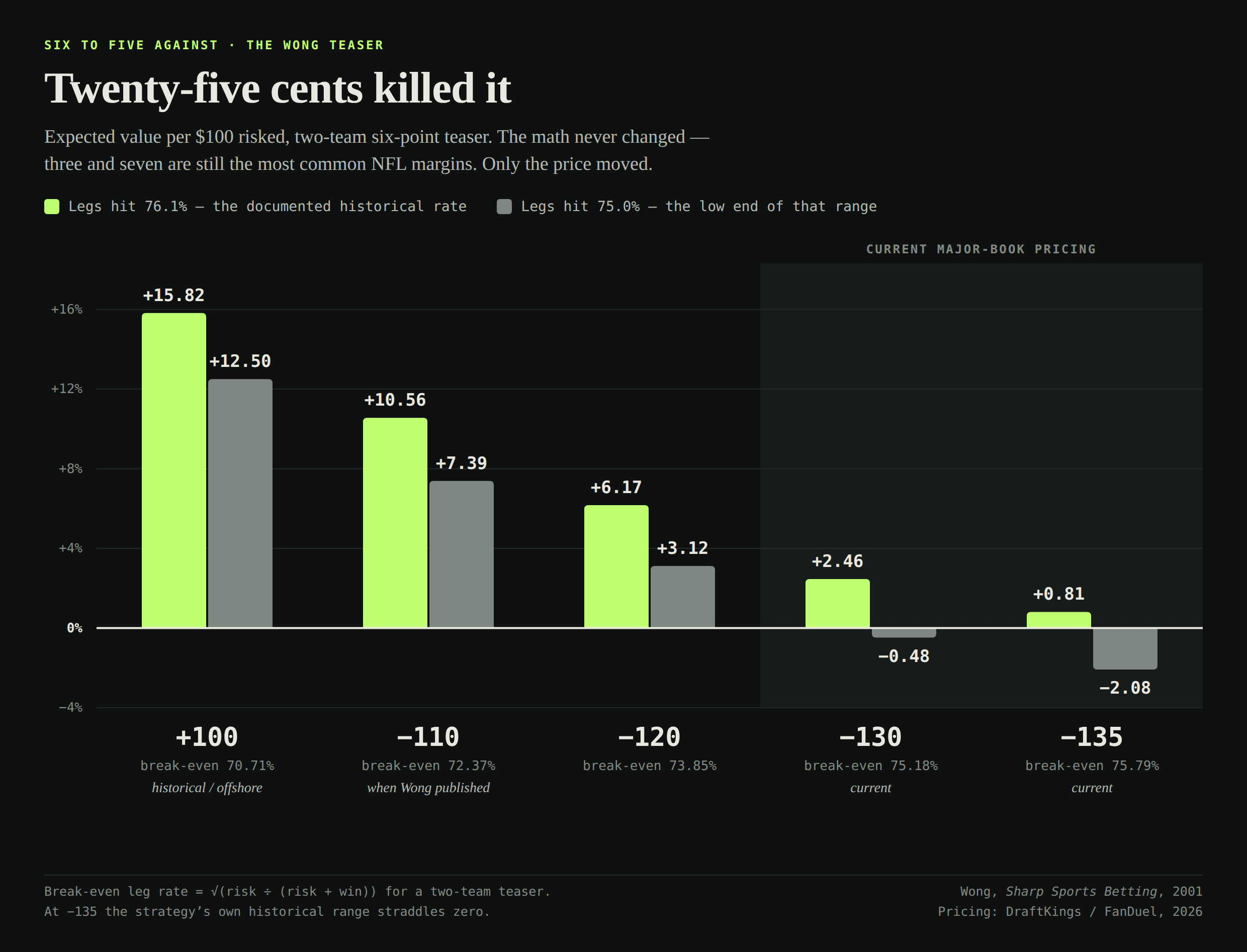
Nobody banned the Wong teaser. Nobody argued with the mathematics. Three and seven are still kings and the paperback is still in print and everything Ferguson wrote in 2001 remains true. What moved was twenty-five cents of juice.
That is the part worth sitting with, because it is not how people imagine markets close an edge. The edge was not destroyed. It was capitalized. The operator layer read the same book everybody else read, calculated what the strategy was worth, and raised the toll to precisely that number. The value did not evaporate. It changed owner. It now belongs to whoever sets the price rather than whoever found it, which is the only durable position in any market and always has been.
The ground is moving too. Two-point conversions have grown common enough that margins of five, six and eight now show up more often than they used to, which drains a little water out of the three-and-seven wells the whole thing was built on. The board is drifting under the strategy at the same time the price is squeezing it from above.
You have watched this happen somewhere with no line attached. The index fund that beat active management until everybody owned one. The arbitrage that lasted eighteen months. The marketing channel that was free, then cheap, then the most expensive line in the budget. The productivity system that worked beautifully for the four hundred people who read it early. The pattern never varies: an edge exists, somebody writes it down, and the writing down is the mechanism of its death. Ferguson’s real discovery was never how to beat blackjack or football. It was that publishing an edge is how you end one, and he proved it twice, on purpose, in two different industries, and named both of them after himself.
Which leaves the last cruelty, and it is small and modern and worth naming. The strategy is still being sold. There is a whole content economy teaching the Wong teaser to people who will go and place it at -135 — running a 2005 play into 2026 pricing, paying a premium for a coin flip and calling it discipline. The edge is dead. The marketing outlived it by a decade.
The sign is still on the table. The book is still on the shelf.
That is what a closed edge looks like: everything exactly where you left it, and nothing in it for you.